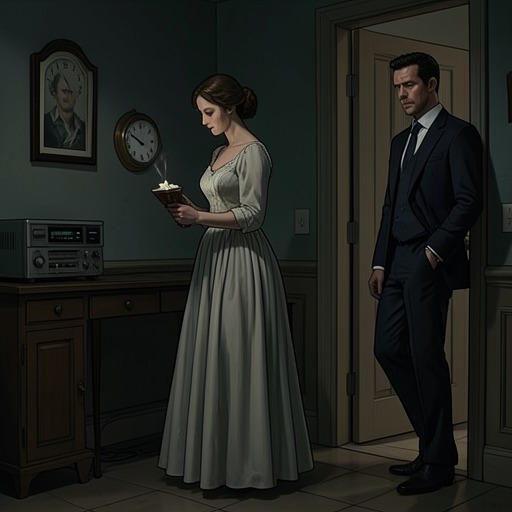
Brett and Andrew’s strained relationship
The Life ListBrett and Andrew’s strained relationship turns on a growing mismatch between the life they share and the life Brett is beginning to want. They have built a familiar domestic partnership around their careers and a lifestyle without children, but Brett’s inherited goals force into view how much of herself she has concealed to preserve that arrangement. Andrew’s first response seems to offer room for change; the coldness that follows makes the promise uncertain, and the relationship eventually appears to break apart.
A partnership shadowed by grief and silence
Andrew and Brett have a substantial shared history: they live together, share a bed, and have been partners long enough for Brett to remember his support before a presentation in Milan. On that earlier occasion, he stayed on the phone through the night so she would feel accompanied. In the present, however, she cannot bring herself to tell him about either her comedy performance or the life list her mother has left her. Beside his sleeping body, she longs to share what is frightening her, then stops herself because explaining the list would mean exposing a part of herself she has kept private.
Her silence is not simply a failure to find the right moment. Brett recognizes that she has hidden her true self and reshaped herself into the kind of woman she believes Andrew wants: unconventional, undemanding, and unencumbered. She questions whether she abandoned her own dreams in pursuit of his approval, then admits that fear of being alone has helped keep her in place. At thirty-four, she imagines leaving as a gamble that could cost her the life she has worked to build. The relationship’s strain is therefore bound up with a conflict within Brett: she wants intimacy, but fears that honesty may make intimacy impossible.
Grief makes the missing confidences especially vivid. In moments when she encounters something funny, Brett instinctively wants to share it with her mother, Elizabeth Bohlinger, whose delight in her stories had been a familiar part of their closeness. Her mother’s note leaves champagne for a toast and a red leather journal for a day when Brett feels stronger; at the will reading, a letter offers sympathy and imagines listening to Brett’s fears. These maternal forms of care provide a striking contrast to Brett’s hesitation with Andrew: she can recall being heard, but is unsure whether her present partner knows the person she has become beneath her practiced accommodations.
The life list brings the conflict into the open
Brett finally tells Andrew the truth, describing the wishes of the girl she once was and the goals she is expected to complete by the following September. His response is mixed rather than simply rejecting. He insists that she should choose what she wants, and recognizes that the aspirations she had at fourteen—to teach and have children—are not the same as the accomplished adult he knows. Yet he also praises their current arrangement: two careers, no children, and no dog, horse, or additional social obligations. What Brett experiences as a chance to recover neglected ambitions, Andrew experiences as a possible upheaval of a life he loves.
His reassurance therefore carries a condition, even if he does not frame it as one: he says their life together is good as it is and asks whether she feels the same. Brett understands that an honest answer may cost her the relationship. Her mother’s lesson about finding courage when afraid presses against her impulse to protect the partnership by agreeing. The exchange exposes the central asymmetry between them: Brett is being asked to choose whether to risk the familiar life, while Andrew can remain committed to it without making the same sacrifice.
When Brett asks whether he will help her reach all her goals, Andrew says that he has no choice. She reads the answer as an offer to put her needs first and imagines that they will have a family, but immediately notices an uneasiness about his motive. Her hope and doubt coexist; agreement has not yet resolved the question of whether Andrew truly wants the future the list requires. The answer matters because his participation would be voluntary, while Brett’s goals are the test through which she is trying to discover what she wants.
Reassurance, distance, and rupture
For a short time, the conversation allows Brett to believe that the relationship can accommodate change. After their decision on Friday night, however, Andrew is colder, and on Sunday he grumbles about going to the office. Brett sends him out with his coat before he can reconsider leaving, while also acknowledging that he has been blindsided by the list, just as she was. She hopes that both of them will need time to adjust to a different lifestyle. Her relief at having the loft to herself sits alongside her effort to explain away his withdrawal: the agreement is real, but its emotional cost is already visible.
Later, Brett’s account of her losses suggests that the partnership has not survived intact. Sleeping on a sofa in her mother’s home, she thinks that Andrew could be difficult and sometimes a jerk, but was still her partner; without him, she fears she will never become pregnant. Her bitterness folds the relationship into a larger sense of catastrophe, alongside the loss of her job and home. The scene does not reduce their conflict to a single disagreement: the rupture touches Brett’s desire for a family, her security, and her dependence on a shared domestic life.
What the relationship reveals
Andrew and Brett’s relationship is strained not because affection is absent, but because affection cannot by itself settle what each expects their shared future to contain. Brett remembers his former attentiveness and wants his support, yet has hidden her ambitions partly to avoid risking the partnership. Andrew can endorse her right to choose while also voicing his preference for the life they already have. That gap gives the life-list disclosure its force: it turns an unspoken incompatibility into a decision neither partner can evade by relying on their familiar routines.
The relationship also clarifies Brett’s changing understanding of love and selfhood. At first, she treats being alone as a possible ruin and staying together as a form of protection. But her reluctance to answer Andrew honestly, followed by her eventual disclosure, shows how that protection has depended on suppressing what she wants. The partnership’s deterioration is thus one of the costs of Brett’s attempt to reclaim her own direction. Her mother’s voice and written messages remain sources of comfort, but they cannot decide for Andrew or make his apparent willingness equivalent to shared conviction. The relationship’s central uncertainty is whether a life built around one person’s unspoken concessions can change without breaking.